Mobile & Portable Cone Crusher Plants for Sale
What is a cone crusher used for?
Last updated:A cone crusher is a secondary or tertiary compression crusher that squeezes pre-crushed rock between an eccentrically rotating steel mantle and a fixed concave bowl liner. It is built for hard, abrasive stone like granite, basalt, and river gravel, producing uniform cubical aggregates at lower wear cost than impactors.
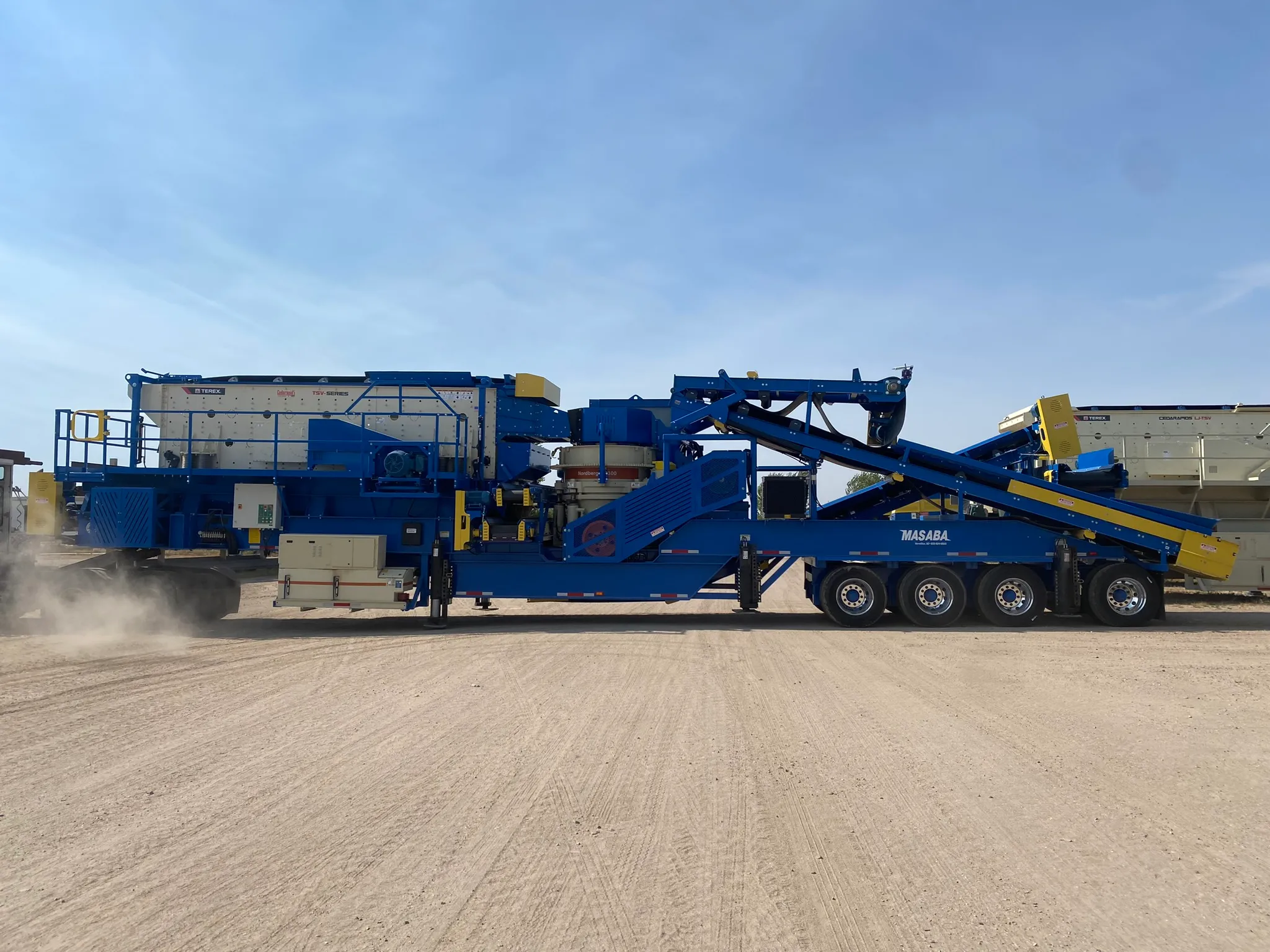
Choosing a Mobile or Portable Cone Crusher for Secondary Crushing
When your quarry or gravel pit processes hard, abrasive stone into tight state-spec aggregates, a dependable cone crusher delivers consistent gradation and predictable manganese wear costs. Used & New Equipments Home offers new and used tracked and wheeled cone crushers from McCloskey International, Masaba, Lippmann, Astec, and Metso. Whether you need a tracked cone plant running inline behind a primary jaw crusher or a portable cone crusher mounted with a multi-deck screen for closed-circuit chip production, our Midwest equipment team helps configure liner profiles, CSS ranges, and conveyor integration.
Where Cone Rock Crushers Deliver Maximum Value
- Hard-rock quarries processing abrasive granite, quartzite, basalt, and trap rock where impactor blow bars wear too fast.
- Sand and gravel operations crushing oversized river cobble into concrete stone, asphalt chips, and manufactured sand.
- Multi-stage aggregate producers running a primary jaw crusher into a secondary cone crusher and triple-deck screener.
- Contractors requiring strict cubical shape and consistent sizing to meet DOT highway and concrete mix specifications.
Cone Crusher Chamber Configurations and Operational Comparison
| Chamber Profile | Typical Stage | Feed Size Requirement | Target Finished Output |
|---|---|---|---|
| Standard Coarse / Medium Cavity | Secondary | Pre-crushed 4"–8" jaw discharge | 1.5"–3/4" clean stone and dense road base |
| Fine / Short-Head Cavity | Tertiary | Screened 1.5"–3" secondary feed | 1/2"–3/8" asphalt chips, pea gravel, fine aggregate |
| Closed-Circuit Cone + Screen | Secondary / Tertiary | Scalped primary feed | Exact top-size spec product with oversize recirculated |
Choke Feeding, Liner Selection, and Hydraulic Tramp Release
Unlike a jaw crusher, a cone crusher performs best when choke-fed—meaning the cavity stays consistently full of rock so inter-particle rock-on-rock compression shapes the stone into strong cubical fragments. Modern tracked cone plants use ultrasonic level sensors above the feed hopper to modulate feed conveyor speed automatically, maintaining optimal choke conditions while preventing overflow.
Equally important are hydraulic CSS adjustment and tramp-iron relief cylinders. Hydraulic adjustment lets operators fine-tune discharge settings under load without shutting down, while nitrogen-charged tramp release cylinders lift the bowl automatically if an uncrushable piece of steel enters the chamber, resetting afterward to protect the main shaft and bronze bushings.
New vs. Used Cone Crusher for Sale Inspection Checklist
A new cone crusher from an authorized line like McCloskey or Lippmann brings factory warranty support, fresh lubrication and oil-cooling systems, and full remaining life on bronze eccentrics and precision gears. For budget-conscious producers, a thoroughly inspected used cone crusher for sale provides high-tonnage secondary crushing at substantially lower capital cost.
Before purchasing any used crusher cone, verify lube-oil sample cleanliness (checking for bronze or steel wear metals), countershaft backlash, mantle and concave thickness, hydraulic clamping pressures, and dust-seal integrity. Used & New Equipments Home conducts multi-point inspections and stocks replacement mantles, concaves, filters, and belts across our Midwest locations.
Pairing Your Cone Plant with Screeners, Conveyors, and Financing
Because cone crushers rely on clean, well-sized feed free of sticky fines, pairing your cone with a tracked mobile screener and radial stacking conveyors keeps the entire spread balanced and bottleneck-free. Our team can package complete primary-to-tertiary spreads for sale or rent across 13 Midwest states, coordinating freight, commissioning, and operator orientation.
Call Used & New Equipments Home at (765) 942-1514 for current cone crusher inventory, spec sheets, weekly or monthly rental options, and commercial financing quotes through Wells Fargo, DLL, BOK, Northland Capital, Ridgestone, or Union Capital Associates.
Cone Crusher: Frequently Asked Questions
Can a cone crusher be used as a primary crusher?
No. Cone crushers are designed for secondary and tertiary crushing and require pre-crushed, reasonably uniform feed—typically from a primary jaw crusher or scalped gravel pit bank. Feeding oversized boulders or sticky fines directly into a cone causes bridging, packing, and uneven liner wear.
Why is a cone crusher preferred over an impactor in hard rock?
In high-silica, abrasive materials such as granite or river gravel, compression crushing between manganese cone liners yields a significantly lower wear cost per ton than high-speed impact blow bars. Cone crushers also produce strong, cubical aggregate ideal for asphalt and concrete mixes.
What does choke feeding a cone crusher mean?
Choke feeding keeps the crushing cavity full of rock at all times so stones crush against each other as well as against the steel liners. This improves cubical particle shape, reduces flat and elongated pieces, maximizes throughput, and promotes even wear across the mantle and concave.
How do I choose between a tracked and portable wheeled cone crusher?
Tracked cone crushers move quickly around the quarry floor with wireless remote control and pair easily with mobile jaw crushers and tracked screeners. Wheeled portable cone plants are built for higher-capacity stationary or semi-portable setups that move by highway between pits on road axles.
Can I rent a cone crusher before buying one?
Yes. Used & New Equipments Home carries tracked McCloskey and Masaba cone crushers in our Midwest rental fleet with published weekly (40-hour) and monthly (176-hour) rates. Call (765) 942-1514 to check availability, delivery schedules, operator training, and purchase or rent-to-own options.